GRAVITY AND DISPERSION: HOW BARCELONA’S ATTACKING CHANGED FROM XAVI TO FLICK
I. Introduction — The Ball as Football’s Gravity
In Until the End of Time, the physicist Brian Greene describes something fundamental about how the universe behaves. According to the second law of thermodynamics, systems naturally tend toward diffusion. Energy spreads out, differences even out, and over long stretches of time everything moves toward a kind of uniformity. If that were the only force at work, the universe would slowly drift toward homogeneity, with matter and energy dispersing evenly in every direction.
But Greene explains that this isn’t the whole story. When gravity becomes strong enough, it changes how the second law expresses itself. Instead of everything spreading out, matter begins to gather. Energy concentrates in certain places and disperses in others. Structure forms. Stars emerge, galaxies assemble, and suddenly the universe becomes far richer and more interesting than simple diffusion would suggest.
While reading that passage, I found myself thinking about football, and more specifically about Barcelona. Because in football there is also a kind of gravitational center, and that center is the ball. Every player on the pitch reacts to it. Defenders shift toward it in order to close space, midfielders move closer to support possession, and attackers constantly adjust their positioning depending on where the ball is and how the defensive line responds. Possession becomes the point around which the entire system reorganizes.
However, teams can organize that reaction in very different ways. Some systems encourage players to move toward the ball, compressing space around possession in order to create short passing connections, triangles, and small areas of numerical superiority. Other systems still allow the ball to attract defensive attention, but they take advantage of that attention by generating movement away from it, with players running beyond the defensive line or stretching the pitch vertically.
In other words, the ball may attract defenders, but the attacking response can either concentrate energy around possession or disperse it across the field.
Barcelona under Xavi Hernández and under Hansi Flick offer a fascinating illustration of these two possibilities. Under Xavi, the attacking structure frequently pulls players closer to the ball. Midfielders move toward possession, combinations form around it, and the game often compresses around the immediate area where the ball is circulating. Under Flick, the ball still draws defenders toward it, but that gravitational pull is more often accompanied by attacking movement that stretches away from the ball, with midfielders and forwards making runs behind the defensive line and creating vertical rotations that expand the available space.
When watching the two teams closely, these contrasting responses to the ball’s gravity begin to appear repeatedly. They shape how Barcelona progress the ball, how the attacking and midfield lines interact with one another, and how the team attempts to break down defensive blocks. In what follows, I will highlight three patterns that consistently distinguish Barcelona’s attacking behavior under Xavi Hernández from what has begun to emerge under Hansi Flick.
II. Pattern 1 — Ball Gravity vs Ball Radiation
The idea for this article began with a question that had been sitting in the back of my mind for a while. Barcelona under Xavi Hernández and Barcelona under Hansi Flick often feature many of the same players. The squad has not completely changed. And yet when you watch the two teams, the attacking behavior can feel noticeably different, both in the rhythm of play and in the way chances appear.
I wanted to understand where those differences were actually coming from.
So instead of starting with tactical theories, I started with the moments that matter most: chances. I looked for the matches in which Barcelona generated the highest expected goals under each manager and then began reviewing the attacking sequences that led to those chances. The goal was not to prove a preconceived idea, but simply to observe how those chances were being created.
What began to appear very quickly was a consistent difference in how players reacted to the ball itself.
In some cases, the ball seemed to attract players toward it. In others, the ball attracted defenders but triggered attacking movement away from it. Returning to Brian Greene’s metaphor, it felt as though one system concentrated energy around the ball while the other dispersed it outward.
That contrast becomes particularly clear when comparing the two managers.
Xavi: Concentration Around the Ball
Under Xavi, the attacking structure frequently draws players closer to possession. When the ball travels into midfield, nearby players tend to move toward it in order to create short passing options and positional triangles. Midfielders often step closer to the ball carrier, attackers position themselves between the lines to receive, and the surrounding structure tightens around the immediate zone of possession.
The intention behind this movement is clear. By concentrating players around the ball, Barcelona create small pockets of numerical superiority that allow them to progress through short combinations. The ball moves from one supporting player to another, defenders are forced to step forward to close space, and gradually the attacking structure begins to manipulate the defensive block.
In these moments the game compresses around the ball. The attacking players gather near possession, circulation becomes quicker, and the defensive structure is gradually pulled out of position.
This pattern appears repeatedly in the sequences from Barcelona’s match against Almería. In several moments the ball enters the interior channel and nearby players immediately move closer to support the action, forming small triangles around the ball carrier. Short combinations then allow Barcelona to progress toward the edge of the box.
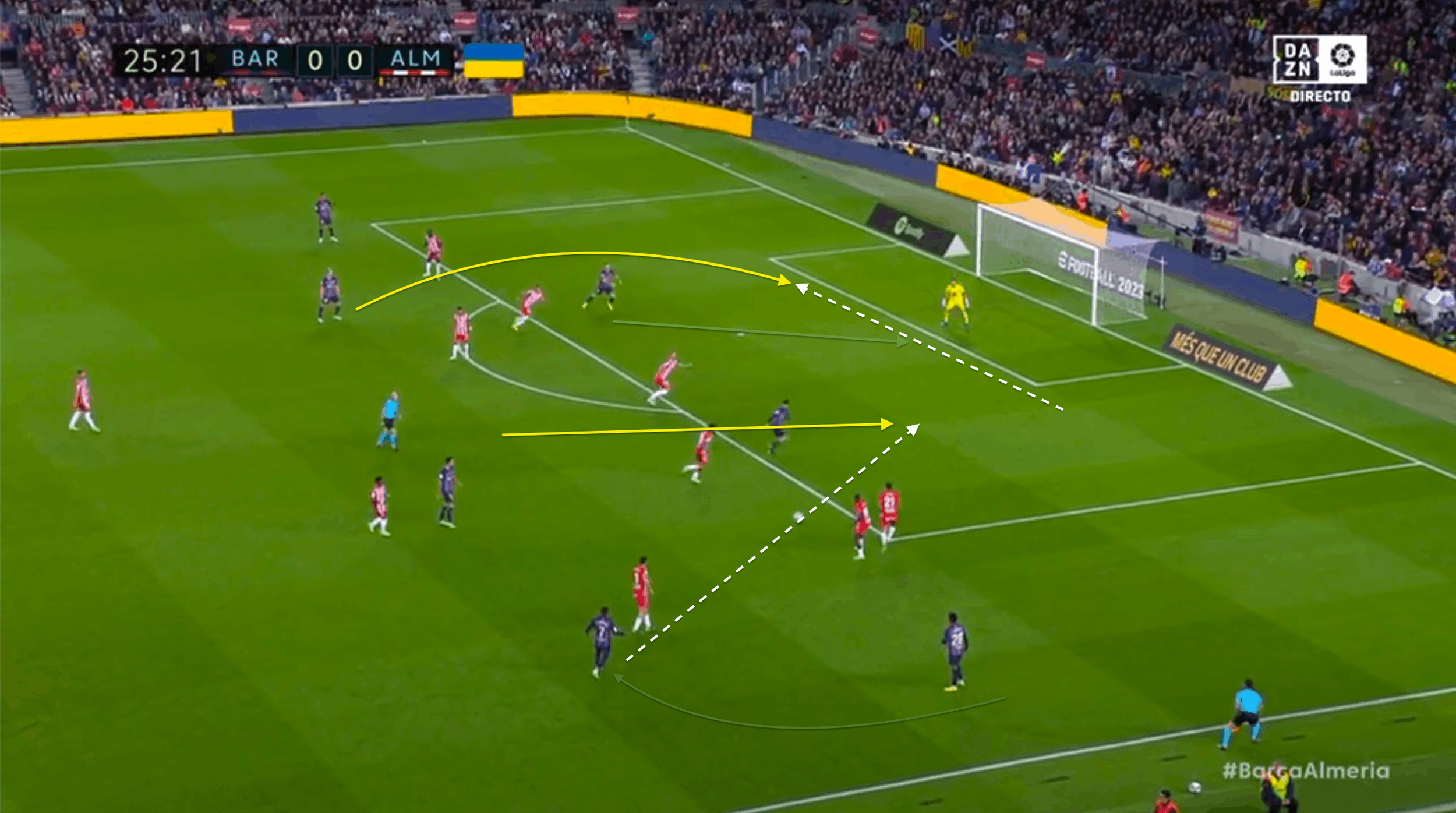
Key: White dotted line = pass, Green line = front line player movement, Yellow line = midfield line player movement, Red line = back line player movement
A similar pattern appears in the Girona match as well. When the ball is received between Girona’s midfield and defensive lines, the surrounding Barcelona players quickly close the distance to offer support, creating a dense cluster of passing options that allows the attack to continue through short connections.
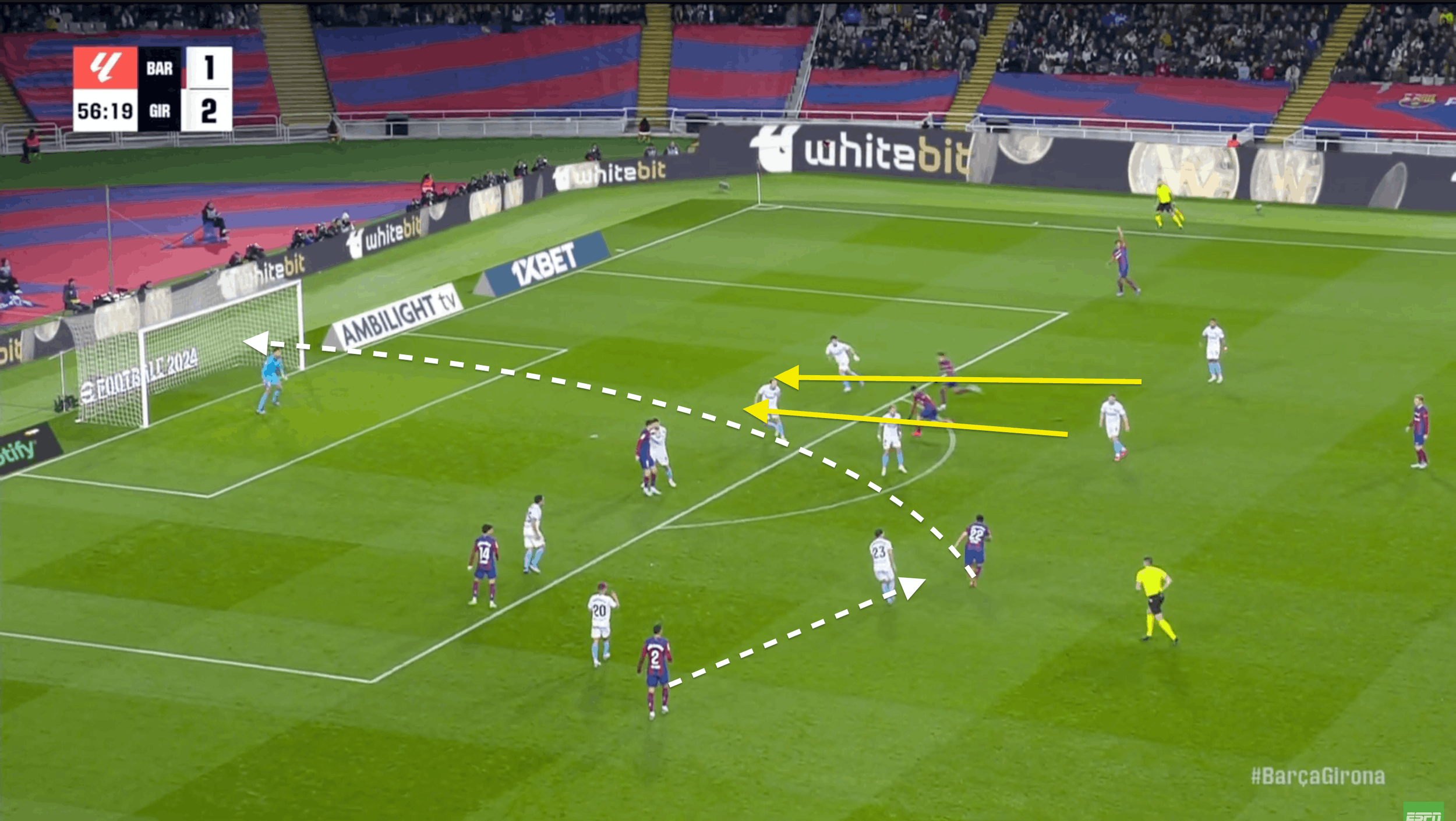
Across these sequences the underlying logic is consistent. The ball becomes a gravitational center that attracts nearby players, and from that concentration Barcelona attempt to progress through combination play.
Flick: Energy Radiating Away From the Ball
Under Hansi Flick, the reaction to the ball often unfolds differently.
The ball still attracts defenders. As possession settles with a center back or a midfielder, the defensive line shifts toward the ball and nearby defenders step forward to close space. But rather than drawing attackers closer to possession, those defensive movements frequently trigger attacking runs away from the ball.
Midfielders begin to run beyond the defensive line. Forwards curve their runs into depth. Diagonal movements stretch the back line both vertically and horizontally.
Instead of compressing around the ball, the attacking structure begins to expand.
The effect is that the moment defenders step toward possession, space immediately opens behind them. Flick’s Barcelona repeatedly use that moment to attack depth, either by passing directly into those runs or by creating situations where the defensive line is forced to turn and run toward its own goal.
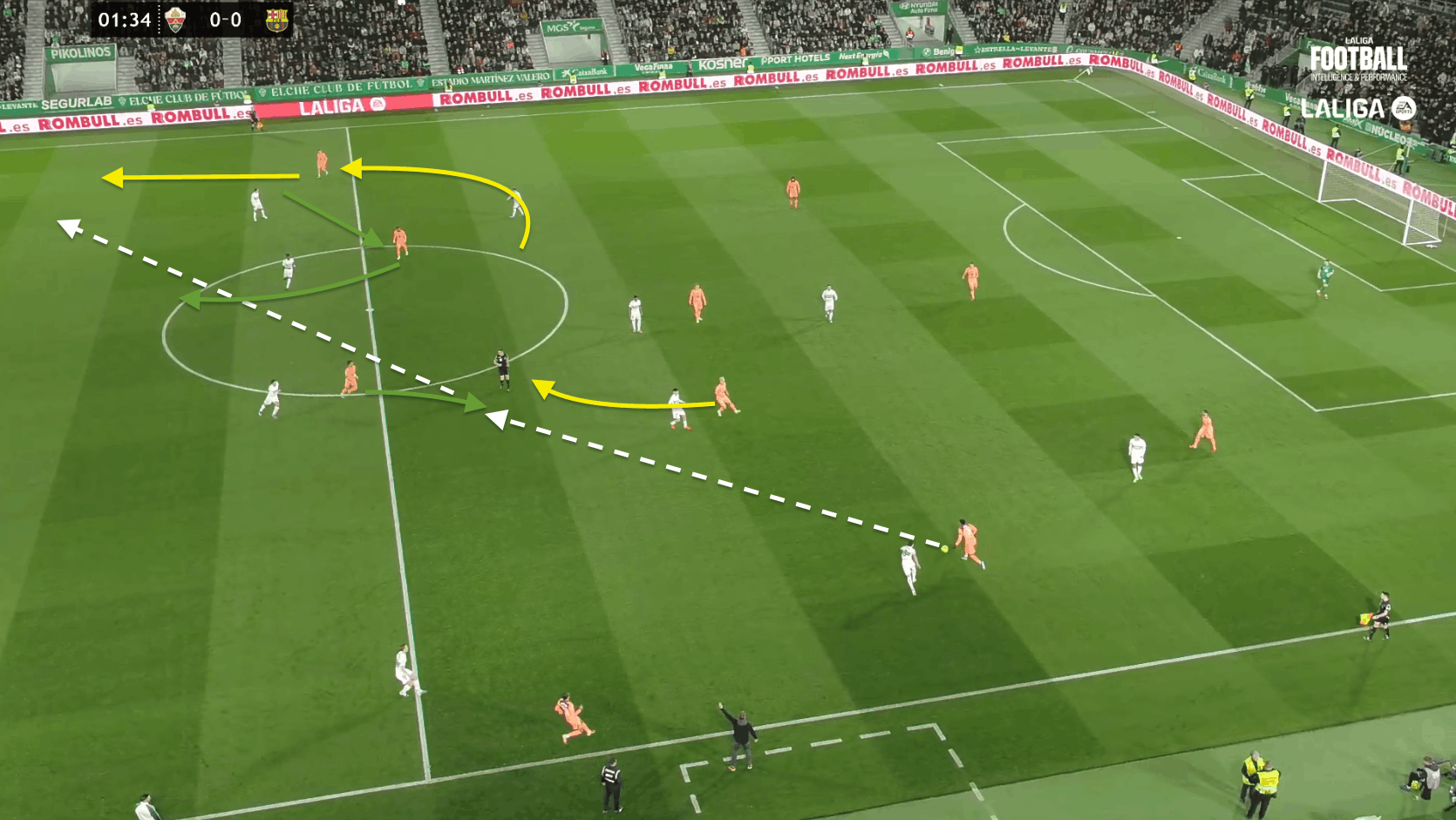
This pattern appears clearly in the match against Elche. In several sequences the ball is controlled by a defender while a forward drops toward midfield and a midfielder simultaneously runs behind the defensive line, creating the possibility of either a short pass to feet or a direct ball into depth.
Another example can be seen in the Valencia match, where midfielders repeatedly attack the space behind the defensive line as soon as the ball carrier is able to lift their head and play forward. The defensive block is forced to retreat, and the attack quickly progresses toward the penalty area.
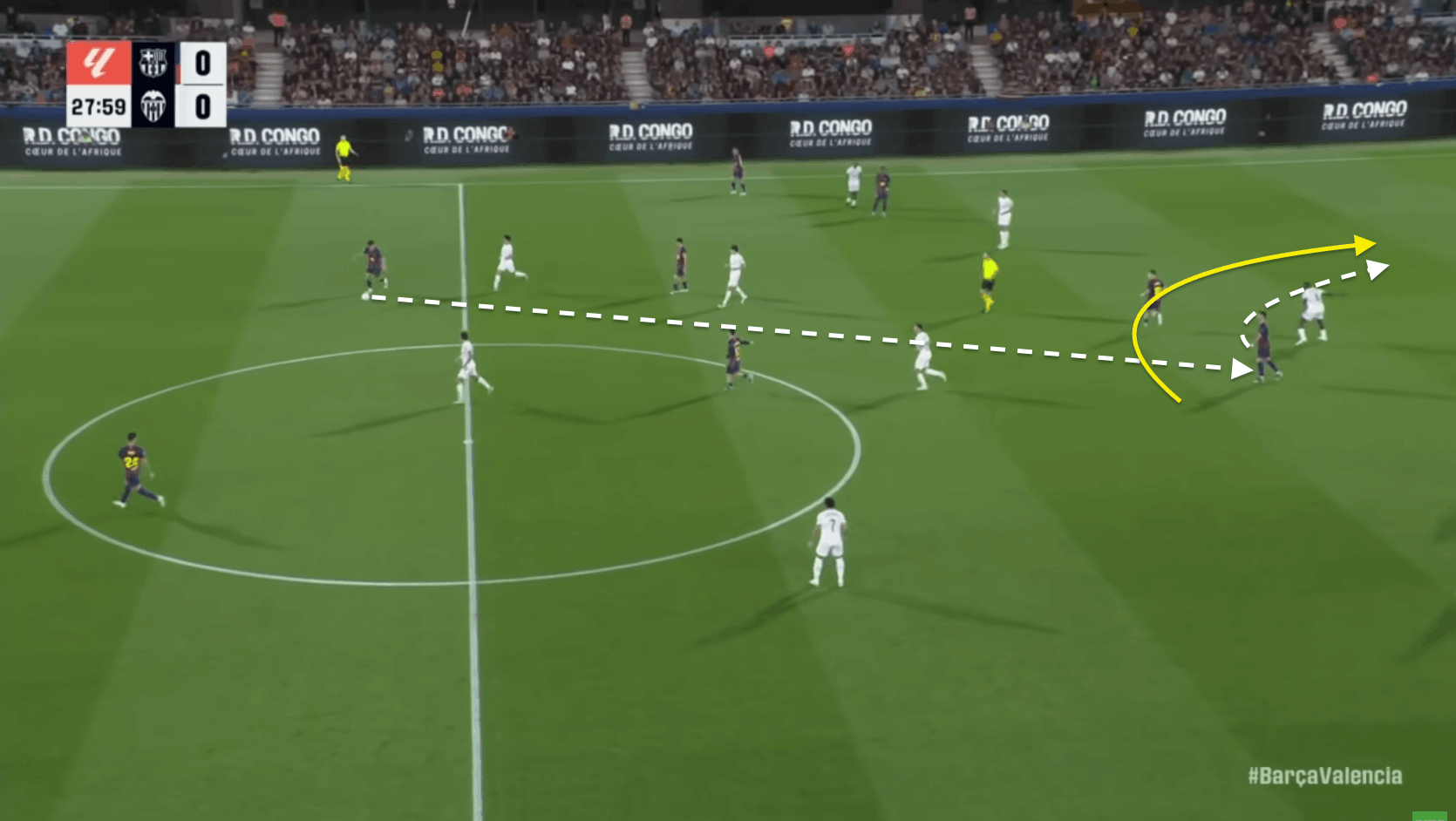
Across these moments the underlying logic remains the same. The ball still attracts defenders, but the attacking reaction is not to cluster around possession. Instead, that defensive attention becomes the trigger for runs that stretch the game vertically.
In one case the ball concentrates players around it. In the other, it becomes the starting point for movement that expands the field.
III. Pattern 2 — Vertical Interchange vs Positional Separation
If the first pattern explains how players move relative to the ball, the second explains how the attacking lines interact with each other. And this is where the difference between the two systems becomes even clearer.
When watching the sequences from Flick’s highest-xG matches, one thing appears repeatedly: the attacking and midfield lines behave almost like a single layer. Players are constantly exchanging depth. A forward drops into midfield, a midfielder runs beyond the defense, and the backline suddenly has two completely different passing options.
Under Xavi, that kind of exchange happens far less frequently. The attacking structure is still dynamic, but the vertical roles tend to remain more defined. The striker stays highest, midfielders occupy the space between the lines, and the wide players stretch the pitch.
Both systems create chances. They simply organize their attacking layers very differently.
Flick: Interchange Between Lines
Under Flick, the movement between the midfield line and the front line is fluid. The two layers behave almost like interchangeable pieces rather than fixed roles.
A typical sequence begins with a center-back in possession. As the defensive line steps forward to apply pressure, a striker will drop into midfield to offer a short passing option. At the same moment, a midfielder will run beyond the defensive line, attacking the space behind. The ball carrier suddenly has two options: play into the feet of the dropping forward or skip the ball directly into depth behind the defense.
This rotation happens quickly enough that the defensive structure often struggles to assign responsibility. If a center-back follows the dropping forward, space opens behind. If the defense holds its line, the forward receives between the lines with time to turn.
The result is that the attacking structure becomes vertically fluid. Midfielders appear on the last line, forwards appear in midfield, and the opponent’s defensive assignments become less stable.
One of the clearest examples appears in the Elche match. Here the winger drops into the midfield space while a teammate attacks the space behind the defensive line.
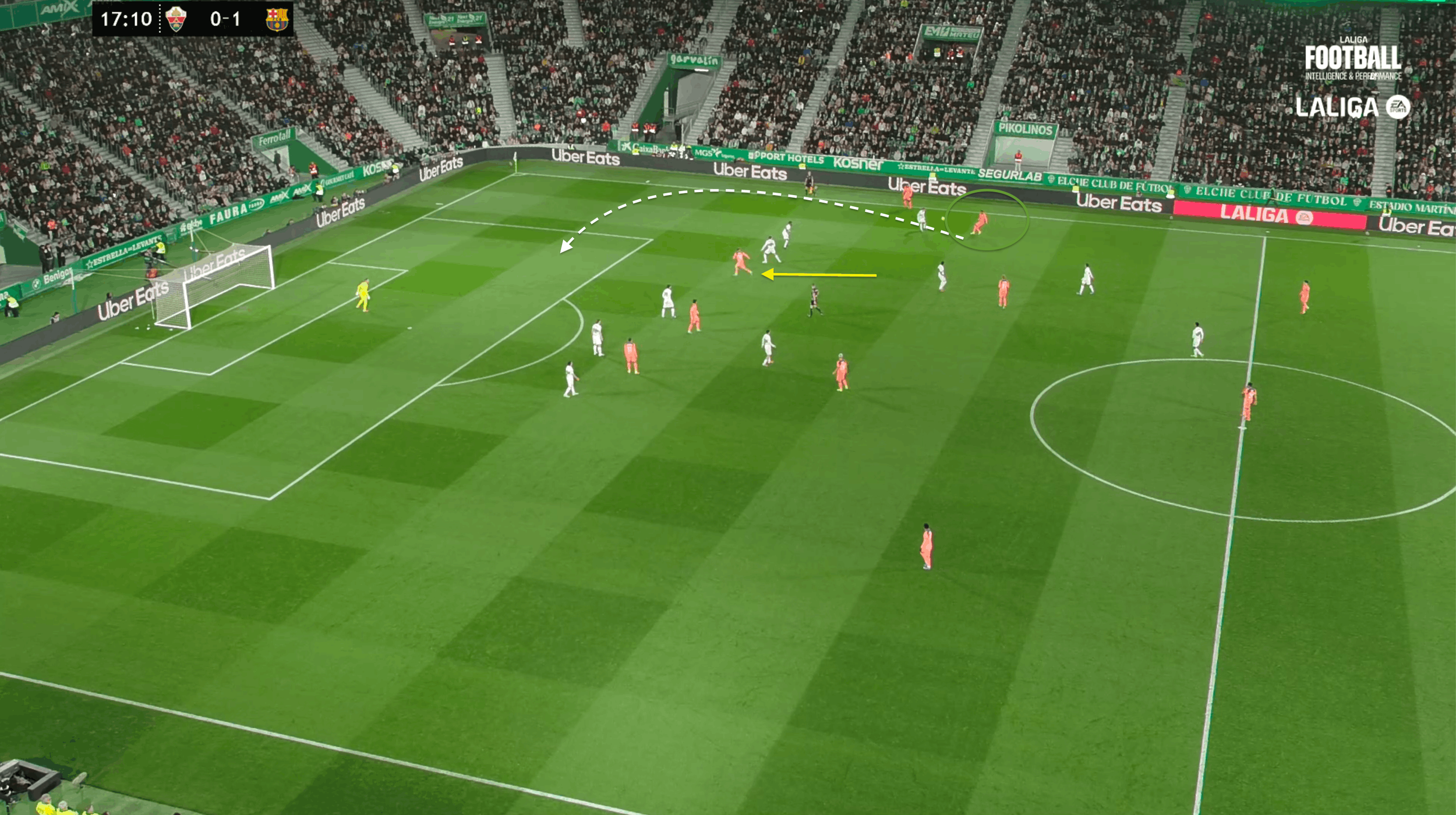
A similar rotation appears later in the same match. As the defensive line shifts toward the ball, a midfielder accelerates into depth while the forward continues to occupy the midfield channel. The attacking layers briefly exchange roles.
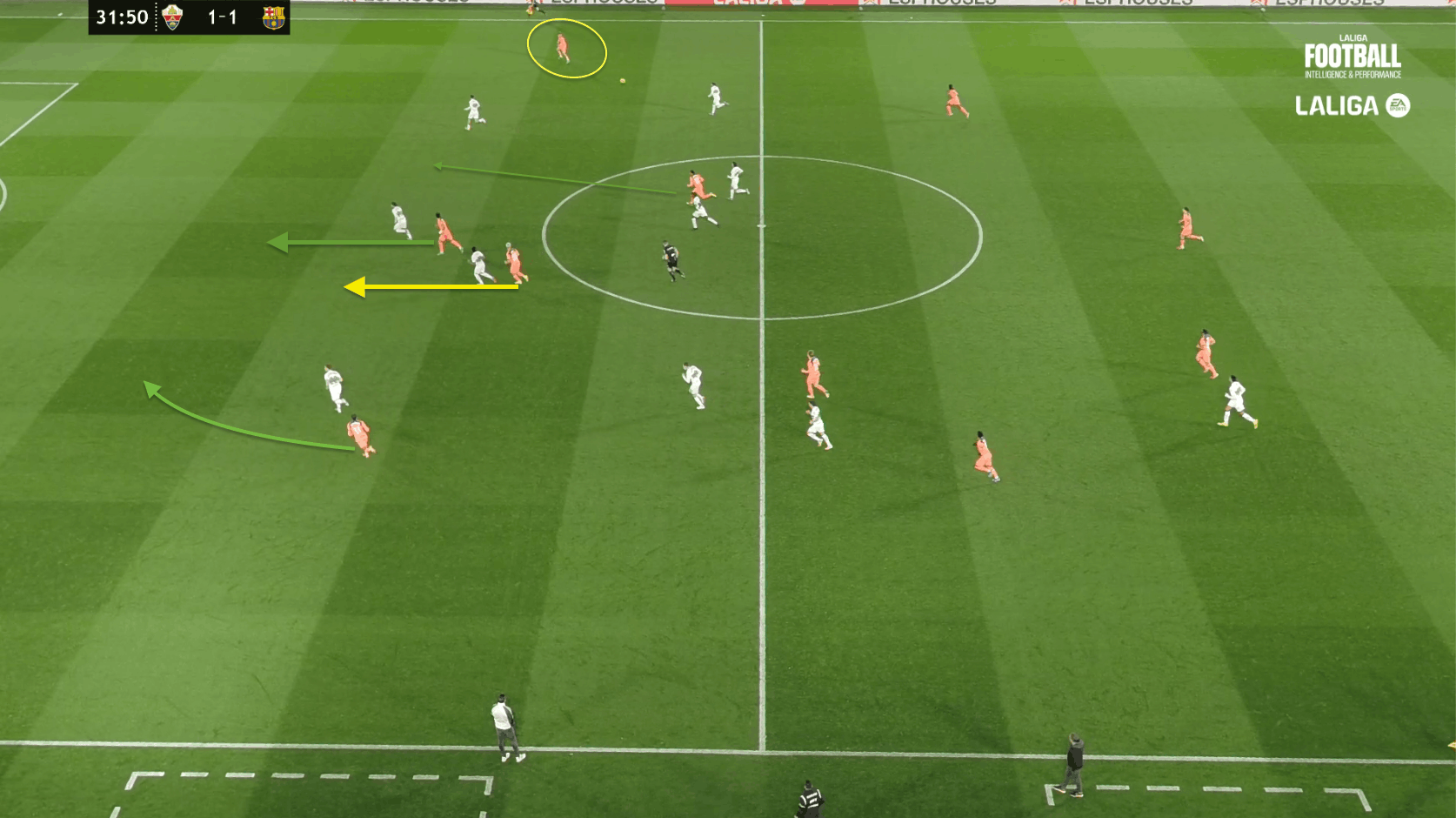
Moments like these appear repeatedly in Flick’s matches. The key idea is not just the run itself, but the rotation that makes the run possible. One player vacates the space, another immediately fills it.
Xavi: Defined Positional Layers
Under Xavi, the structure of the attacking lines tends to remain more clearly defined. The striker generally occupies the highest position in order to pin the defensive line, midfielders operate between the lines where they can receive and combine, and the wide players stretch the pitch horizontally.
Rather than exchanging vertical positions with each other, players tend to move within their zones.
The striker may check toward the ball occasionally, but the primary objective is to remain high enough to threaten the defensive line. Midfielders rotate and combine with each other between the lines, while fullbacks frequently provide width by overlapping outside the wingers.
The result is a structure that feels more stable. Each line maintains its function within the positional framework, and the attack progresses through circulation rather than through vertical rotation.
A clear example appears in the Real Madrid match. Barcelona progress the ball through midfield combinations while the striker continues to occupy the last line, maintaining the depth of the attacking structure rather than exchanging positions with midfield runners.
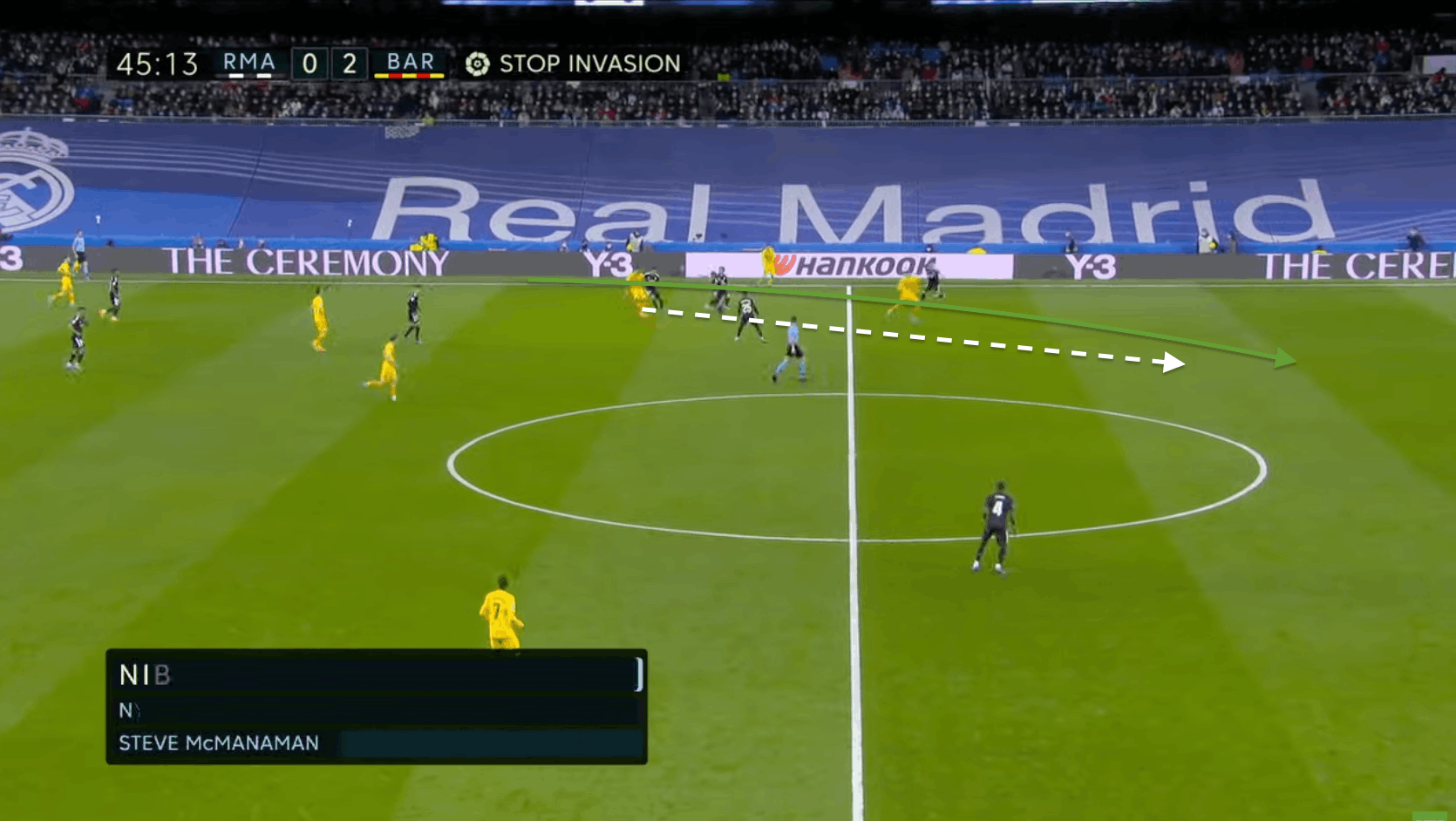
A similar structure appears in the Girona match. Midfielders circulate the ball between the lines while the striker stays central and the wide players hold the width, allowing the team to manipulate Girona’s defensive block without breaking the positional framework.
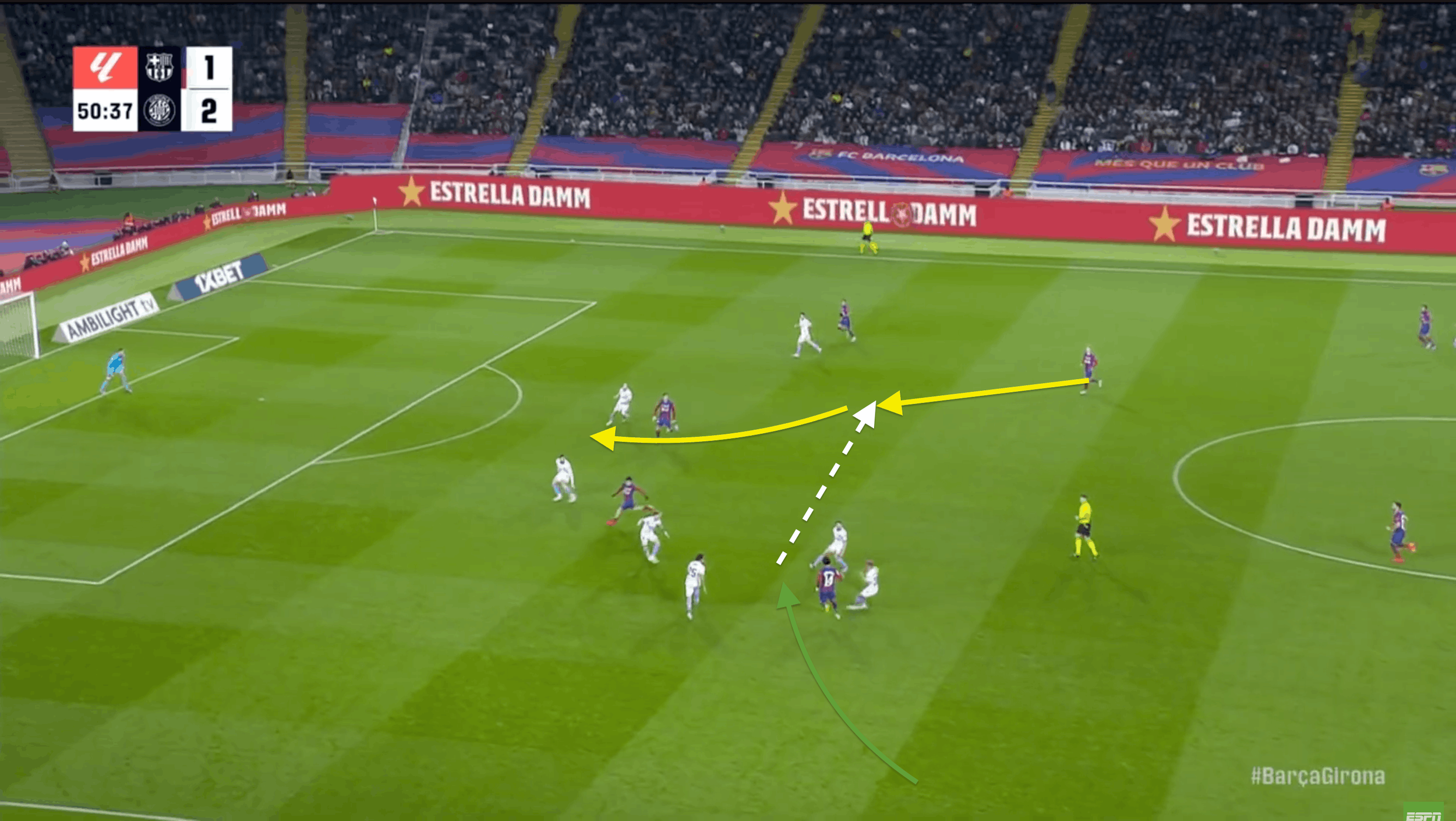
Across these moments the contrast becomes clear. Flick’s system frequently produces vertical exchanges between the attacking and midfield lines, creating a fluid structure where players trade depth. Xavi’s system maintains clearer positional layers, with players primarily operating inside their assigned zones while the team circulates the ball to manipulate the defense.
IV. Pattern 3 — Through the Block vs Around the Block
The first two patterns explain how players move relative to the ball and how the attacking lines interact with each other. The third pattern shows where those differences become most visible: when Barcelona are facing a settled defensive block.
When space behind the defense is limited and the opponent has time to organize, teams usually have two options. They can try to stretch the defense horizontally, moving the ball from side to side until a gap appears. Or they can attempt to break through the defensive block directly, attacking the central corridors before the defense has time to fully stabilize.
Barcelona under Flick and Barcelona under Xavi tend to favor different solutions.
Flick: Penetration Through the Block
Under Flick, even when Barcelona are facing an organized defensive shape, the attacking sequences often continue to look vertical. Rather than patiently circulating the ball around the outside of the block, the team frequently attempts to break the defensive structure through central combinations, quick vertical passes, or individual actions that carry the ball through the middle of the pitch.
Runs behind the defensive line are still present, but even when those runs are not immediately available, the attacking players continue to look for central access points. A midfielder receives facing forward, a forward checks toward the ball, and a quick combination suddenly opens a lane through the middle.
Fullbacks in these situations often function more as supporting players than as the highest attacking outlet. Instead of consistently overlapping on the outside to deliver crosses, they tend to combine inside or help create the passing angles that allow the ball to move through the block.
The objective is not to stretch the defensive block around its edges, but to destabilize it from within.
The contrast between attacking through the block and attacking around the block becomes particularly clear in moments like these.
In the first example, from the Valencia match, Barcelona receive the ball centrally just outside the penalty area. The defensive block is already compact, with multiple Valencia players positioned between the ball and the goal. Rather than circulating the ball wide to stretch the defense horizontally, the attack immediately looks for a way through the middle.
The midfielder receives facing goal and plays a vertical pass directly into the feet of the forward between the lines. At the same moment, another attacking player begins to move across the defensive line, occupying the center-backs and preventing them from stepping aggressively toward the ball. The action is quick, compact, and entirely central.
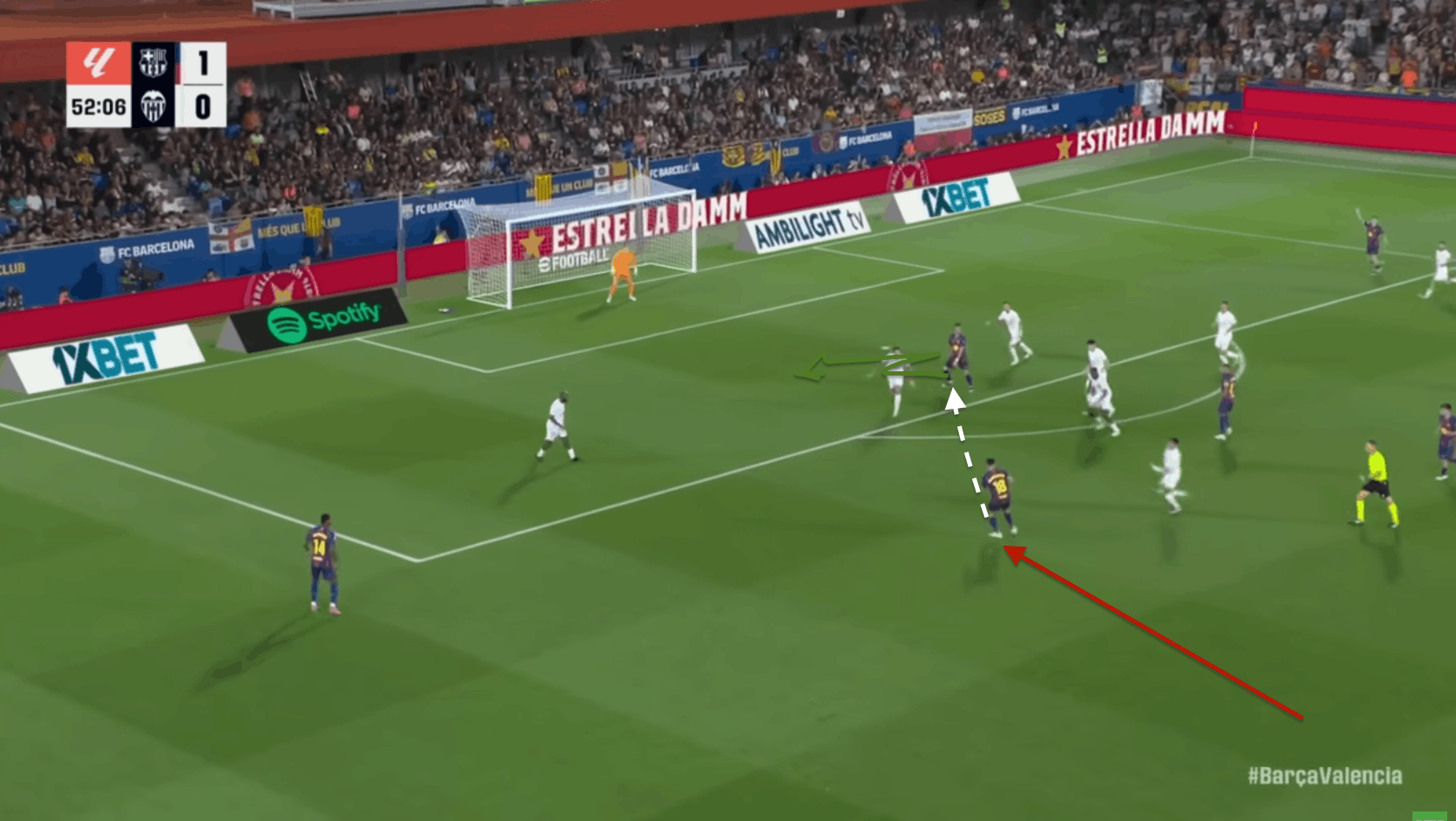
Key: White dotted line = pass, Green line = front line player movement, Yellow line = midfield line player movement, Red line = back line player movement
The important detail is not just the pass itself, but the intention behind it. The attack does not attempt to move the defensive block first. It tries to break it immediately, using a short central combination before the defense has time to reorganize.
The second example, from the Osasuna match, shows a similar idea but earlier in the attacking phase. Here the ball is circulating in midfield while Osasuna maintain a compact defensive structure ahead of the ball. Instead of moving the ball toward the wing to stretch the block horizontally, Barcelona play forward through the central corridor.
A midfielder receives between the lines while another player positions himself just ahead of the defensive midfield line. The two attackers briefly occupy the same vertical lane, drawing defenders toward the center and opening the possibility for the next pass to continue through the middle of the structure.
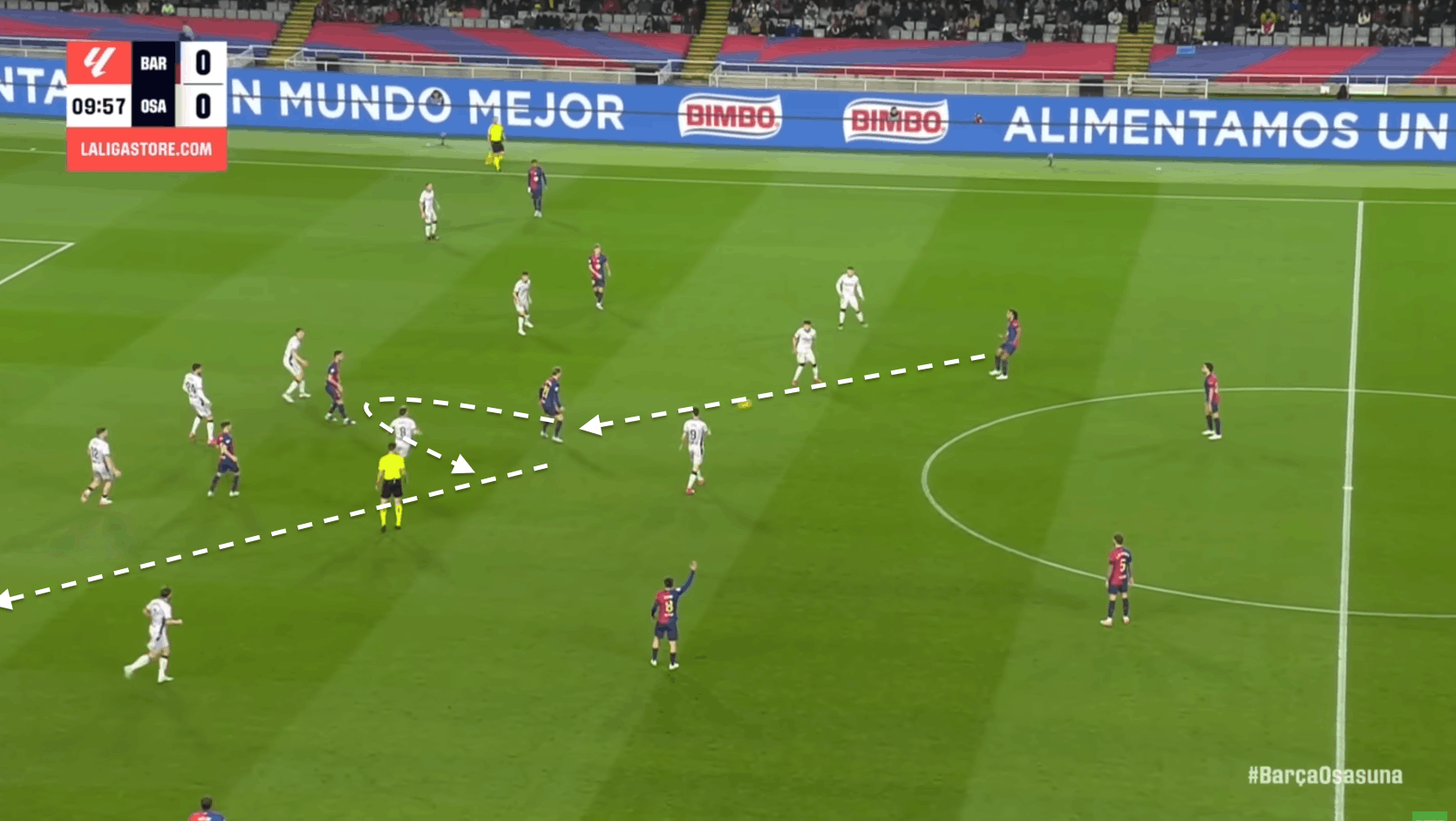
Again, the key idea is where the attack is directed. The ball is not traveling around the defensive block, waiting for the right moment to deliver a cross. Instead, the attacking sequence is aimed directly through the central corridor, asking whether the block can be broken before it has time to fully stabilize.
Moments like these illustrate the broader tendency that appears across Flick’s matches. Even when the defense is set, Barcelona often look for ways to penetrate centrally through quick combinations, vertical passes, or dribbles that attack the middle of the structure.
The block is not stretched first.
It is challenged immediately.
Xavi: Manipulation Around the Block
Under Xavi, the attacking approach against a settled block often develops differently. Rather than immediately attempting to penetrate the defensive structure through the center, Barcelona frequently begin by circulating the ball across the width of the pitch. The purpose of this circulation is to move the defensive block horizontally, gradually creating gaps that can then be attacked.
Wide players and fullbacks play a major role in this process. Wingers hold their width to stretch the defense, while fullbacks often overlap on the outside to create two-versus-one situations in wide areas. Once the ball reaches these zones, the attack frequently develops through half-space crosses or cutbacks delivered from near the edge of the penalty area.
In these moments the defensive block is not broken directly through the middle. Instead, it is pulled apart gradually until the final action becomes possible.
In contrast to the central penetration that often characterizes Flick’s attacking patterns, many of Barcelona’s attacking sequences under Xavi begin with a different intention. Instead of immediately trying to break the defensive block through the center, the attack first attempts to move the block, stretching it across the width of the field until new spaces appear.
The first example, from the Real Madrid match, shows this process beginning on the right side of the pitch. Barcelona are in possession near the touchline while Madrid maintain a compact defensive structure around the top of the penalty area. Rather than forcing a pass through the center where several defenders are already positioned, the ball carrier pauses and scans across the defensive line.
Two Barcelona players are positioned deeper and wider on the far side, creating the possibility of switching the attack across the field. The intention is not to break the defensive structure immediately, but to shift it. By moving the ball toward the opposite side, Madrid’s defensive block would be forced to slide horizontally, opening new spaces between players that can later be attacked.
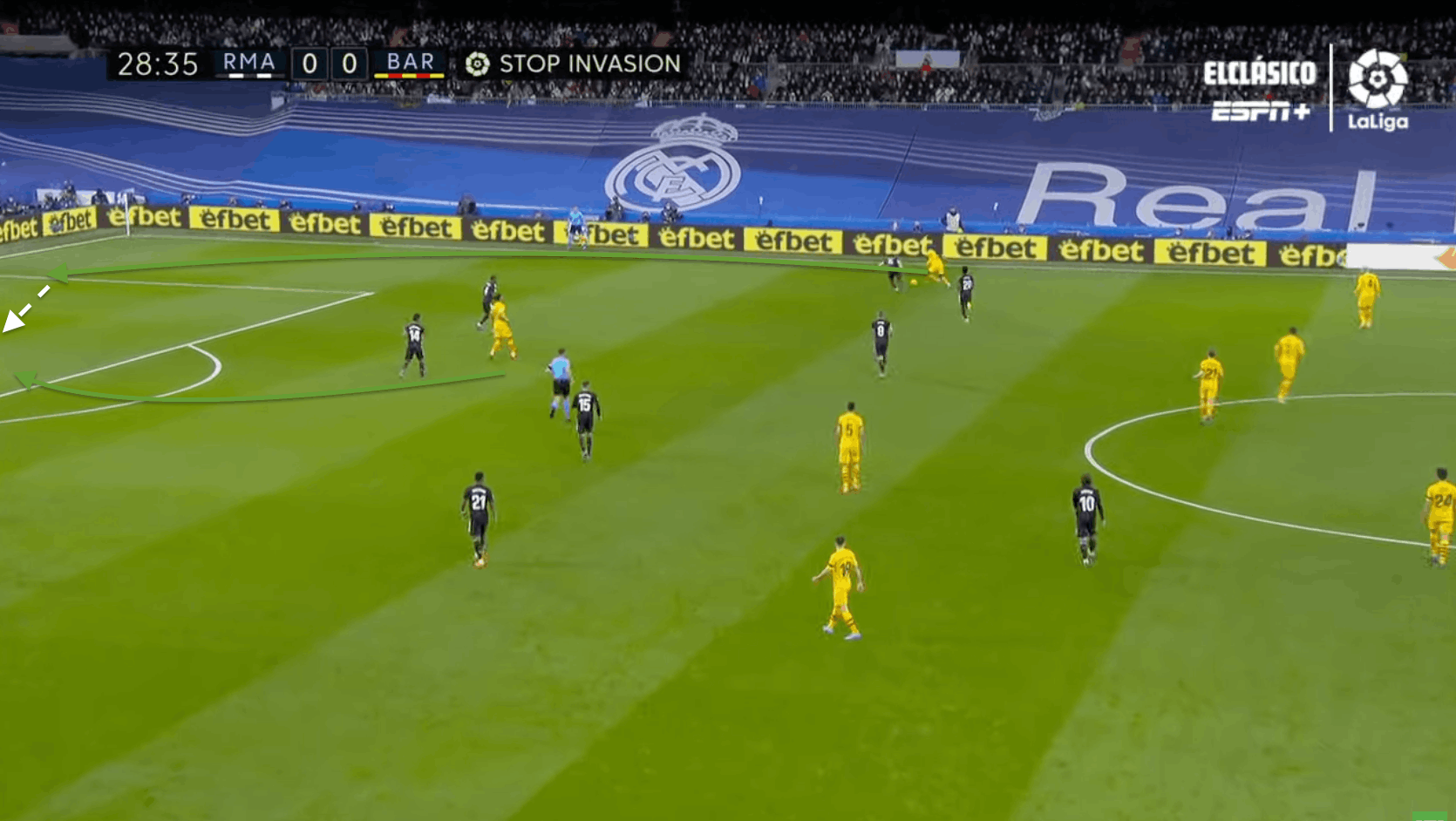
The key detail here is how the attack is organized around width. The far-side player holds a wide position, stretching the defensive line, while the players closest to the ball circulate possession patiently. The attack expands laterally before attempting to penetrate.
A similar idea appears in the Almería match, but now closer to the penalty area. Barcelona progress down the left side of the field while Almería’s defense collapses toward the ball. Several defenders shift toward the near side, forming a dense cluster around the dribbler near the edge of the box.
Instead of attempting to force a central pass through this congestion, the attacking sequence continues along the outside corridor. The ball carrier drives toward the byline, drawing additional defenders toward the wing while teammates position themselves inside the box in anticipation of a cross or cutback.
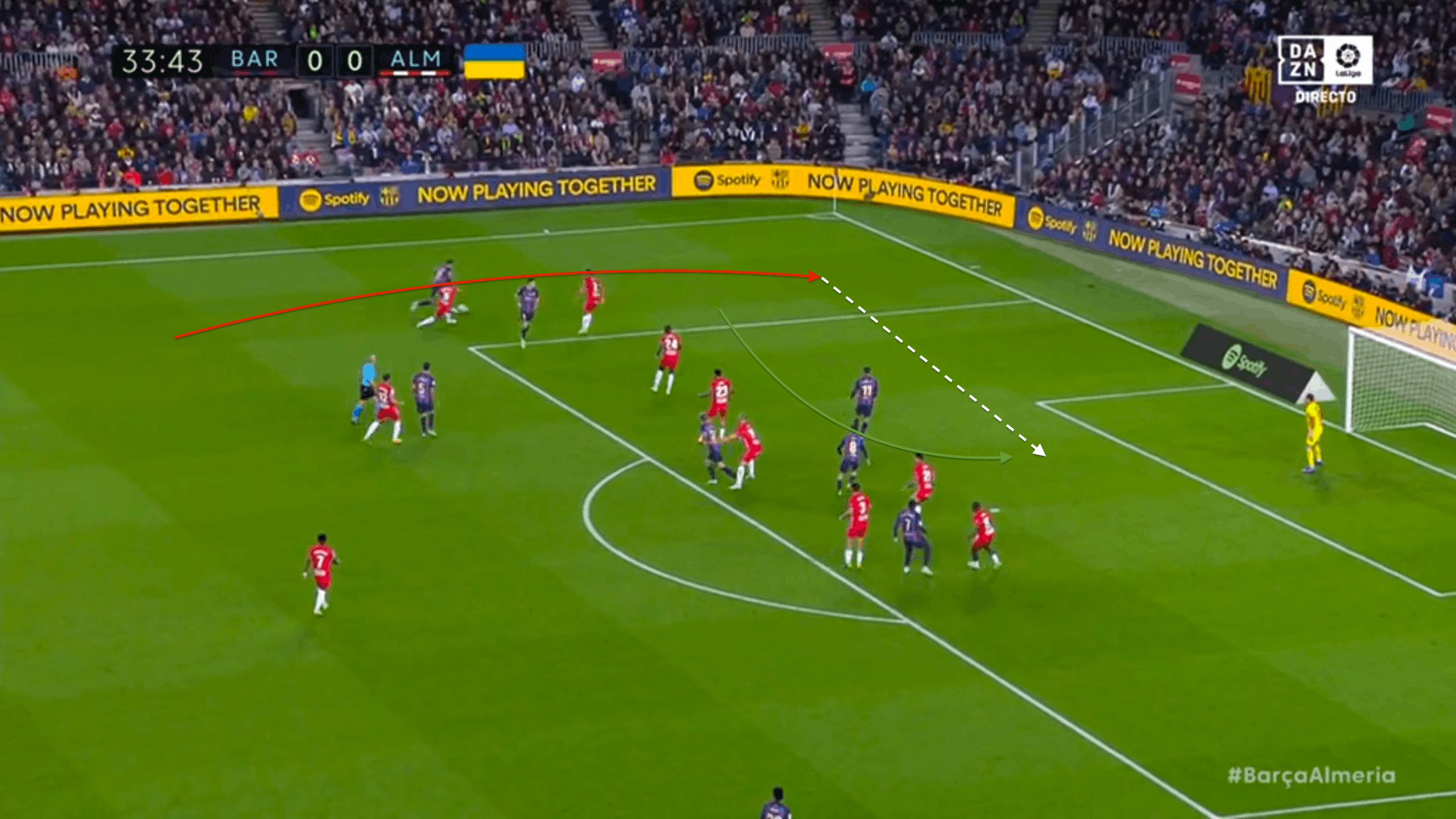
Here again, the defensive block is not attacked directly through the middle. The attack develops around the defensive structure, using width and movement along the flank to destabilize the line before the final pass arrives.
Across many of Xavi’s matches, these patterns appear repeatedly. The ball circulates across the width of the pitch, the defensive block shifts and stretches, and only then does the decisive action occur, often through a cross, a cutback, or a late run into the box.
Where Flick’s attacks often ask whether the block can be broken immediately through the center, Xavi’s sequences more often begin by asking a different question.
How far can the block be moved before it finally opens?
V. Why the Difference Matters
The contrast between these patterns is not simply stylistic. It shapes how the entire attacking phase unfolds, how defensive structures are manipulated, and ultimately how scoring chances are produced.
Under Xavi, the attacking structure tends to remain compact and positionally organized. Players occupy clearly defined zones across the pitch, and the ball circulates patiently between them. Midfielders position themselves between the lines, wingers stretch the width, and fullbacks advance along the outside corridors. Because these roles remain relatively stable, the attacking structure maintains a consistent shape around the ball.
This positional clarity allows Barcelona to manipulate defensive blocks gradually. As the ball moves from side to side, the opposition must shift with it, sliding horizontally across the field to maintain their defensive spacing. Over time, small gaps begin to appear between defenders. The decisive action often arrives only after this movement has stretched the defensive structure to its limits.
The objective is not immediate penetration.
It is positional control, maintained long enough for the defense to eventually open.
Flick’s attacking patterns create a different kind of pressure on the defensive structure. Instead of prioritizing positional stability, the attack introduces vertical instability as early as possible in the sequence. Strikers drop into midfield, midfielders run beyond the defensive line, and defenders step forward with aggressive passes that break lines.
Because players exchange positions across vertical layers of the field, the defensive block cannot simply slide from side to side while maintaining its structure. Each forward pass and each run behind the line forces defenders to make immediate decisions: step forward, drop deeper, or pass the responsibility to another defender.
The attack does not wait for the defensive block to move.
It attempts to destabilize it immediately through depth and vertical movement.
Both systems are capable of producing high-quality chances, but they do so through very different spatial strategies. Xavi’s structure seeks to shape the defensive block before penetrating it, while Flick’s approach often attempts to disrupt the block first and exploit the instability that follows.
In one system, the attack patiently rearranges the defense until the right opening appears.
In the other, the attack tries to create that opening as quickly as possible.
VI. Conclusion — Two Responses to the Ball’s Gravity
Throughout the article, the contrast between the two teams can be understood through a simple physical metaphor.
The ball acts like a form of gravity within the game. Wherever it travels, defenders are naturally drawn toward it. Their movement compresses space around the point of possession, creating density and pressure near the ball while leaving other areas of the field less protected.
Attacking teams must decide how they respond to this gravitational pull.
One option is to move toward the ball, concentrating players around the area where possession is held. When teammates approach the ball carrier, short passing options appear, triangles form naturally, and the attack can combine in tight spaces. The defensive block becomes increasingly compressed as more players are drawn toward the same zone of play.
This was often the pattern visible in Xavi’s Barcelona. Midfielders moved closer to the ball, attackers received between the lines, and the structure of the team remained compact around possession. The ball functioned as a focal point that organized the attack, gradually shaping the defensive block until a final opening appeared.
The alternative response is to move away from the ball.
As defenders step toward possession, attacking players use that movement as an invitation to run beyond them. Instead of concentrating around the ball, teammates radiate outward from it, attacking the spaces that open behind or beside the defensive line. Vertical runs, diagonal movements, and forward passes stretch the defensive structure immediately.
This tendency appears frequently in Flick’s Barcelona. While one player attracts pressure on the ball, others accelerate away from it, pushing the defensive line deeper and forcing the opposition to defend space behind them.
Both responses exploit the same fundamental dynamic of the game.
The ball attracts defenders.
But the attacking team can choose whether to gather around that gravity or release energy away from it.
In that sense, the difference between the two approaches becomes surprisingly simple.
Xavi’s Barcelona treated the ball as a center of gravity.
Flick’s Barcelona treats it as a source of momentum.
WANT TO DIVE DEEPER?
If you enjoy looking at the game through patterns like these, this is exactly the type of thinking we explore inside the How to Analyze Football Course.
Across five weeks we break down real matches, study recurring tactical structures, and train the ability to see the game beyond the ball.
Registration closes March 5th.
If you want to sharpen how you watch football, this is your chance to join.